oda is a pure-R implementation of the MegaODA / CTA
classification engine. It provides three main tools:
-
oda_fit()- Optimal Data Analysis (ODA): univariate binary or multiclass classification with a single attribute. -
cta_fit()- Classification Tree Analysis (CTA): recursive ODA-node trees with ENUMERATE, LOO STABLE, and MINDENOM endpoint constraints. -
Translation and graphics - endpoint staging,
propensity weights, tree plots, and NOVOmetric bootstrap CIs via
cta_staging_table(),cta_propensity_weights(),novo_boot_ci(),plot.cta_tree(), and the ggplot2 renderersplot_cta_tree()/plot_lort_tree()(requires ggplot2).
Binary ODA
oda_fit() finds the single cutpoint that maximises Mean
PAC (percentage of accurate classifications, averaged across classes
with inverse-frequency weighting when priors_on = TRUE).
ESS (Effect Strength for Sensitivity) measures how far Mean PAC exceeds
the chance benchmark of 50%.
library(oda)

x <- c(1, 2, 3, 4, 5, 6, 7, 8)
y <- c(0L, 0L, 0L, 0L, 1L, 1L, 1L, 1L)

fit <- oda_fit(x, y, mcarlo = FALSE)
print(fit)
#>
#> ODA (binary)  attr_type=ordered  priors=TRUE  n=8
#>
#> Rule: <= 4.5 --> 0   |   > 4.5 --> 1
#>
#>   CLASS       n     PAC
#>       0       4  100.0%
#>       1       4  100.0%
#>
#>   Mean PAC: 100.00%   ESS: 100.00%
The fitted rule, per-class PAC, Mean PAC, and ESS are available directly:
fit$rule$cut_value    # cutpoint
#> [1] 4.5
fit$rule$direction    # which side maps to class 1
#> [1] "0->1"
fit$ess               # ESS (%)
#> [1] 100
Classification Tree Analysis
cta_fit() grows a binary classification tree in which
each split node is an ODA model. mindenom sets the minimum
leaf size; mc_iter controls the Monte Carlo permutation
test used to screen candidate splits; loo = "stable" keeps
only splits whose leave-one-out ESS matches the training ESS.
The example below uses a small synthetic dataset. For publication
analyses use at least mc_iter = 5000L.
X <- data.frame(
  x1 = c(1, 2, 3, 4, 5, 6, 7, 8),
  x2 = c(0L, 0L, 1L, 0L, 1L, 1L, 0L, 1L)
)
y <- c(1L, 1L, 1L, 1L, 2L, 2L, 2L, 2L)

tree <- cta_fit(X, y,
  priors_on  = TRUE,
  mindenom   = 2L,
  mc_iter    = 500L,
  mc_seed    = 42L,
  loo        = "off",
  attr_names = c("x1", "x2")
)
print(tree)
#>
#> CTA Tree  alpha_split=0.050  mindenom=2  prune=1.000  max_depth=10  loo=off
#>
#> ATTRIBUTE      NODE  LEV    OBS       p      ESS     WESS      LOO  MODEL
#> ----------------------------------------------------------------------------------
#> x1                1    1      8   0.026  100.00%  100.00%      OFF  <=4.5-->0; >4.5-->1
#>   Node-local split confusion (this rule only, observations at this node)
#>                    0      1
#>              --------------
#>        0  |       4      0 | 100.00%
#>        1  |       0      4 | 100.00%
#>              --------------
#>       NP  |       4      4
#>
#> Nodes: 3 total  (1 split  2 leaf)
#>
#> Terminal endpoints (*):
#> * endpoint 1  node 2:  path=x1<=4.5  n=4  counts=[0:4 1:0]  predicted=0  target_prop=0.0%
#> * endpoint 2  node 3:  path=x1>4.5  n=4  counts=[0:0 1:4]  predicted=1  target_prop=100.0%
#> ESS: 100.00%  D: 0.0000  strata: 2  min_denom: 4
plot(tree)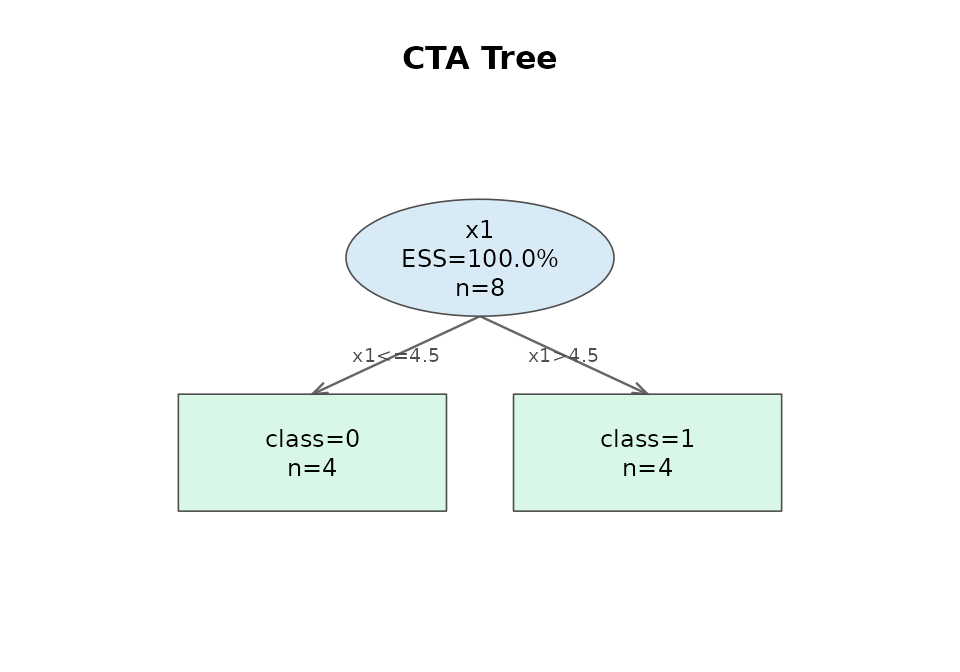
Further reading
The public pkgdown article series currently focuses on stable, publication-ready workflows:
| Article | Content |
|---|---|
| ODA basics |
oda_fit() in depth: rule, PAC, ESS, LOO |
| Directional ODA | Directional binary ODA and fixed/identity-map categorical examples |
| Multiclass ODA | C >= 3 class variables; PAC per class; K-class chance benchmark |
| CTA basics |
cta_fit(): MINDENOM, LOO STABLE, ENUMERATE,
pruning |
| CTA graphics |
cta_plot_data() data contract;
plot.cta_tree() and plot_cta_tree()
renderers |
| NOVOboot CI |
novo_boot_ci(): fixed-confusion NOVOmetric bootstrap
for binary 2 x 2 confusion tables |
The example-driven package vignettes are available after installing
with build_vignettes = TRUE and running
browseVignettes("oda"):
| Vignette | Content |
|---|---|
| Binary ODA: Migraine Attacks | Binary ordered ODA example |
| Binary Ordered Directional ODA: The Refugee Act | Directional ordered ODA example |
| Binary Categorical ODA: Gully Erosion | Nondirectional MegaODA parity run for the gully example |
| Multiclass Categorical ODA: Protein Type | Nondirectional MegaODA parity run for the protein example |
Note: Some longer-form draft articles, including the full practitioner guide, validation tiers, CTA translation, MDSA family, and myeloma CTA walkthrough, are intentionally withheld from the public site until their examples and artifacts are finalized.