oda provides two levels of CTA tree visualisation:
-
Base-R renderers (
plot.cta_tree,plot.cta_ort): no external dependencies; structural diagram via base graphics. -
ggplot2 renderers (
plot_cta_tree,plot_lort_tree): requires the ggplot2 package; richer control over colour and layout.
Both share the same data contract: cta_plot_data() (for
CTA trees) and ort_plot_data() (for LORT trees) produce
renderer-independent plot-data objects. You can pass either the fit
object directly or a pre-computed plot-data object to any renderer.
cta_plot_data(): the renderer-independent data
contract
cta_plot_data() extracts node/edge geometry, split
rules, class counts, and terminal predictions from a fitted
cta_tree object. The result is a self-contained plot-data
object usable by any renderer.
library(oda)

set.seed(1L)
n <- 60L
X <- data.frame(
  x1 = c(rnorm(30, mean = 2), rnorm(30, mean = 5)),
  x2 = c(rnorm(30, mean = 1), rnorm(30, mean = 3))
)
y <- c(rep(1L, 30), rep(2L, 30))

tree <- cta_fit(X, y,
  mindenom   = 12L,
  mc_iter    = 300L,
  mc_seed    = 42L,
  loo        = "off",
  attr_names = c("x1", "x2")
)

pd <- cta_plot_data(tree)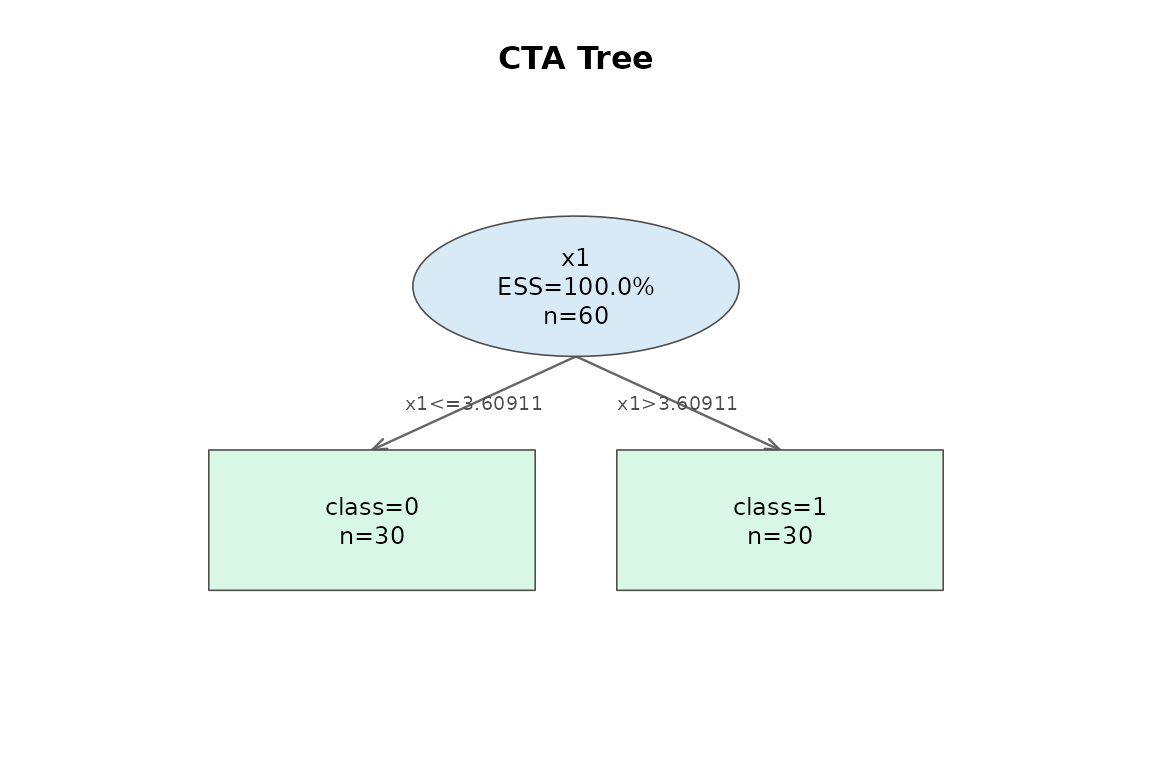
Graphics v3: ggplot2 renderers
plot_cta_tree() requires ggplot2 (in Suggests). The
function accepts either the fit object or pre-computed plot-data.
color_by controls terminal-node fill:
-
"none"(default): white fill - B/W, publication-ready with no legend. -
"prediction": discrete fill by predicted class. -
"target_rate": continuous gradient by target-class proportion.
plot_cta_tree(pd, color_by = "prediction")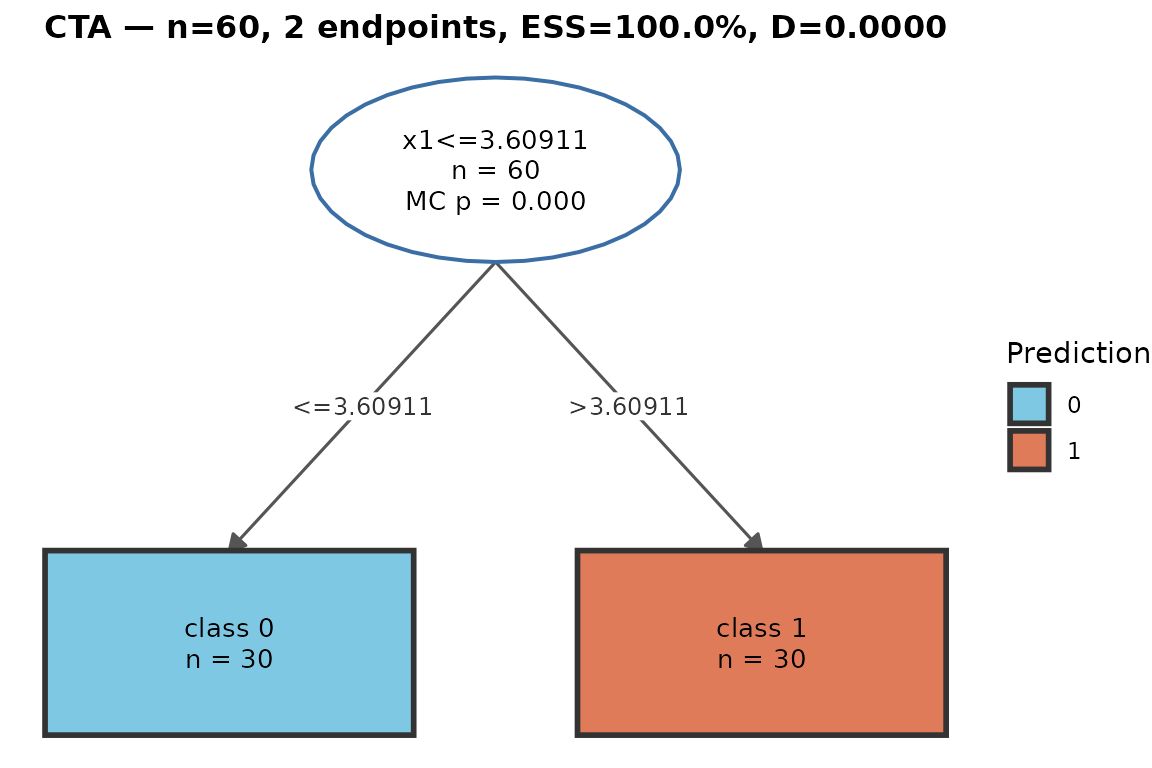
# target_rate: gradient showing proportion of class 1 per node
plot_cta_tree(pd, color_by = "target_rate", target_class = 1L)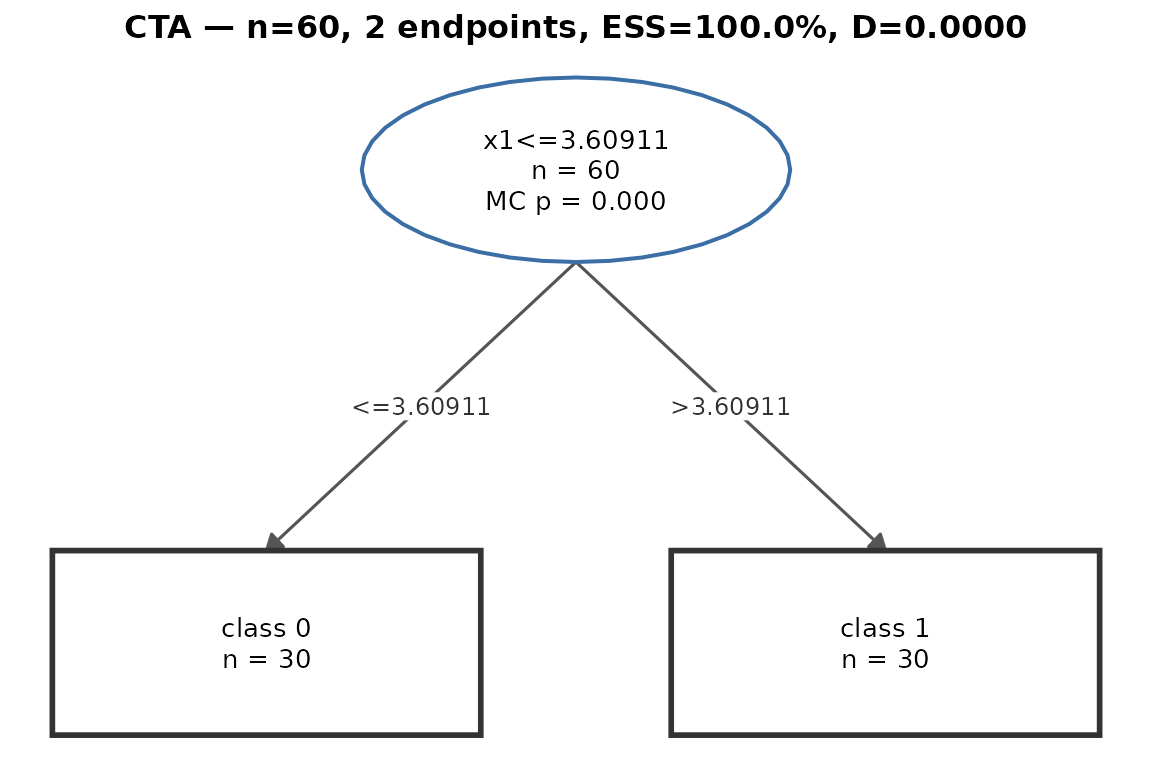
Saving to file:
if (requireNamespace("ggplot2", quietly = TRUE)) {
  p <- plot_cta_tree(pd)
  ggplot2::ggsave("cta_tree.png", p, width = 8, height = 5, dpi = 150)
}
Endpoint label content
Each leaf label shows the predicted class, total n at the endpoint,
and (when target_class is set) the raw target-class count
and proportion. These values come directly from the per-leaf
class_counts_raw stored at fit time - no recomputation
occurs inside the renderer.
Endpoint colouring encodes relative target-class proportion within this tree only. It does not imply prevalence, risk, or any external reference standard.
LORT trees
LORT (Locally Optimal Recursive Trees) are displayed by indexed
sub-tree inspection. plot_lort_tree(lort, index = k)
renders the CTA sub-tree at LORT node k.
show_all = TRUE returns a named list of ggplot objects.
lort <- lort_fit(X, y, mc_iter = 300L, mc_seed = 42L, min_n = 12L)
# Root sub-tree (default index = 1)
plot_lort_tree(lort, color_by = "prediction")
# All sub-trees as a named list
all_plots <- plot_lort_tree(lort, show_all = TRUE)
Further reading
-
docs/GRAPHICS_V3.md- full v3 function reference, examples, andggsaveusage -
articles/cta-basics- CTA fitting andpredict.cta_tree()